For many homeowners across Phoenix and the Valley, pre-summer residential maintenance is a seasonal ritual that should not be ignored. With the incoming summer heat, you likely focus on your HVAC system, but your plumbing is just as important. At AZ Family Plumbing, our service crews are often busy checking pressure regulator valves and inspecting plumbing systems in April, which is also a good time to prepare water softening systems for the summer.
The Advantage of Summer-Ready Water Softeners
The extreme heat conditions of Phoenix summers translate into increased water demand. Residential plumbing systems and appliances like washers and water heaters are under higher stress in the summer, not only from usage but also from higher mineralization levels.
During the cooler months, the Central Arizona Project directs more surface water from rain and snowmelt to the Valley. This water is generally softer because it doesn’t sit in mineral-rich aquifers for years. When surface water evaporates at reservoirs, its molecules escape into the atmosphere, but minerals like calcium and magnesium don’t. As temperatures rise, more water evaporates, which leaves a higher concentration of minerals behind. This makes the water harder before reaching the treatment plant.
Phoenix water management districts increase their sourcing of water from aquifers in the summer. These underground sources are very rich in calcium and magnesium, substantially more than Salt River water. As the intensity and frequency of heat waves increase in the Valley, harder water will continue to be an issue for Phoenix homeowners to consider in the summer.
Water softeners are wise home investments in Phoenix; they strip away harsh minerals from municipal water, improving taste and smell. They also protect major appliances and plumbing fixtures from limescale buildup. Summertime’s increased evaporation makes softening systems more crucial, especially because you’ll likely use more water between the heat, more people being present in your home, and so on. Scheduling a maintenance call in April lets you handle your water softener before we become busier during the warmer season.
Understanding Water Softener Functionality and Maintenance
The lifespan and efficiency of water softeners are partially determined by how regularly they receive maintenance. To understand why AZ Family Plumbing strongly recommends April water softener maintenance, it is worth learning about system components and processes.
Water softening is accomplished through an ion exchange process. Thousands of tiny resin beads inside the equipment are charged with sodium ions. As hard water with high calcium and magnesium concentrations flows through the resin bed, the beads act like magnets; they attract and capture mineral ions before replacing them with sodium molecules. Thanks to this ion exchange, softened water flows to your various points of use, including faucets, showers, dishwashers, water heaters, and others.
By eliminating the high mineral content of summer Phoenix water, you can notice a significant improvement in taste and clarity. The flavor compounds in coffee and tea don’t have to compete with the taste of calcium or magnesium. Similarly, soft water is often better for meal preparation as well. Hard water interacts in strange ways with soap, body wash, and shampoo, which can make it harder to clean tubs and showers. It can also dry out your skin and hair, leading to irritation. Limescale buildup can not just tarnish fixtures, but it can also eventually clog your plumbing and corrode it. Maintaining your water softener helps ensure that your water-using appliances operate more efficiently during the summer months.
Over time, the resin beads promoting the ion exchange process become saturated and mineralized. Softeners use a backwash regeneration cycle to maintain functionality. During the regeneration cycle, water softeners release a brine solution to flush the accumulated minerals down the drain, recharging the beads for the next round. The system becomes less effective as the resin gets coated by sediment.
Water softener maintenance in April prepares the hydromechanical components for heavy summer usage. Our plumbers check the brine tank for “salt bridging,” a reaction that forms crusts and disrupts the salt dissolution process. We also check the control valve and clean the injector screen, verifying the regeneration process isn’t wasting salt or water.
Maintenance Beyond Salt Refills
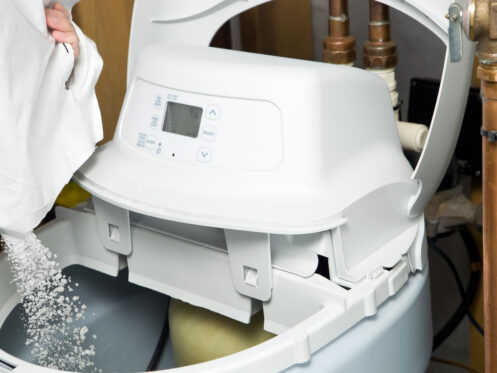
Water softening systems depend on adequate salt levels for peak performance. Most systems need a salt refill every two to four months; however, checking monthly can help you prevent getting caught off-guard and needing to refill the system last-minute. It also helps ensure your water stays at maximum softness. When our plumbers complete water softener maintenance calls, they ensure you are using the manufacturer-recommended salt type to maintain your system’s efficiency.
Breaking up salt bridges is a common maintenance item. Although they mostly form when you use the incorrect salt type, other factors contributing to bridge formation include high humidity and overfilling, even when you use the manufacturer-recommended salt. They will also form over time because salt absorbs moisture from the air, causing it to clump and recrystallize.
Salt mushing occurs when salt dissolves and then recrystallizes at the bottom of the brine tank. Instead of a bridge, you get a dense sludge of semi-crystallized salt. Daily water softening causes recrystallized salt to accumulate and obstruct the pickup tube, thus blocking the system from drawing the brine needed to recharge the resin bed. At AZ Family Plumbing, our experience with mushing is that it often requires a full manual cleaning of the tank to restore proper function. If you eliminate salt mushing in April, you won’t have to worry about sudden obstructions during the peak summer months.
The condition of the resin bed is a critical factor in your system’s performance; it is the hydromechanical element that functions as the engine of your home’s water softening system. Over time, the resin beads lose their capacity to soften. When you book a water softener maintenance call in April, our plumbers apply a specialized treatment to strip contaminants away from the resin bed, thus rejuvenating the beads and restoring their ion-attracting properties.
The Venturi valve is the component that creates the suction to draw the brine solution into the resin tank. We check this valve as part of our pre-summer water softener maintenance services; it can get clogged with fine sediment and mineral debris, particularly when the Valley’s water chemistry changes in the summer. Our plumbers test the valve and thoroughly clean the assembly to ensure it is free of debris.
We check all the connections to your plumbing system. We inspect and test the bypass, intake, and outtake valves for optimal functionality and safety. These valves isolate the softener during maintenance or emergencies, allowing you to bypass the system. The internal O-rings and seals within these valves deteriorate over time, often faster when the system is in your garage or utility closet.
When we test the valve mechanisms, we ensure the materials are holding up against mineral corrosion. This confirms your system is not only filtering correctly but also standing by for service, repair, replacement, or upgrades.
The Bottom Line of Pre-Summer Water Softener Maintenance in Phoenix
Booking a maintenance call for your water softening system in April is a proactive measure to ensure you don’t have to deal with hard water during the Phoenix summer. At AZ Family Plumbing, we can combine water softener maintenance with plumbing services like leak detection and repair, repiping, hydro-jetting, water treatment, drain cleaning, and many others.
To learn more about summer water softener maintenance in Phoenix, please contact AZ Family Plumbing today.